
Patient lift systems help caregivers, healthcare professionals and patients to safely and comfortably transfer and lift their patients. These systems are crucial for people with limited mobility like seniors, disabled individuals, and those recovering from surgeries or injuries.
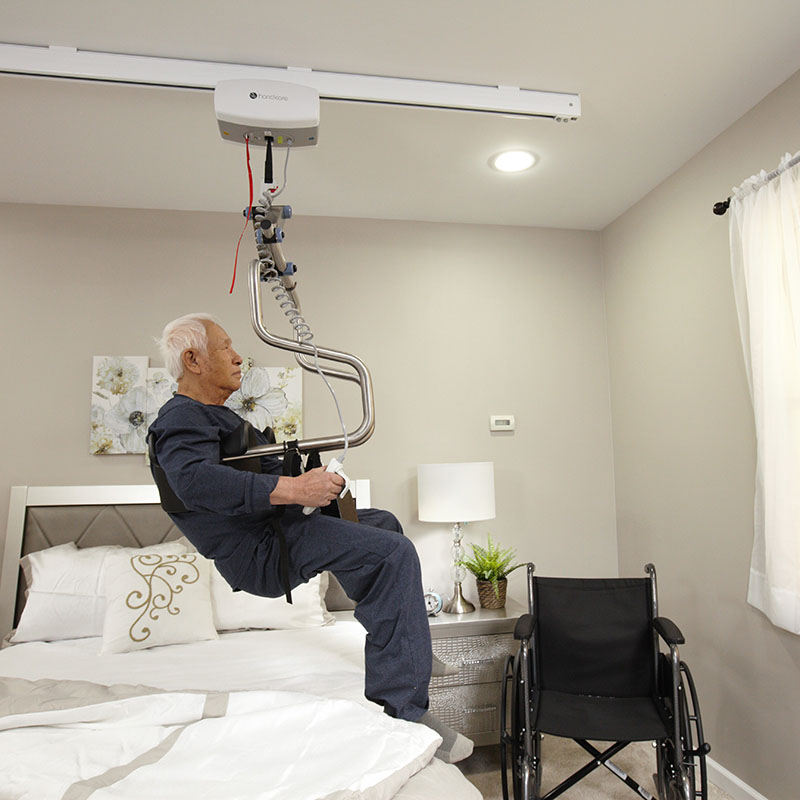
There are several types of patient lift systems available on the market, including mechanical lift transfer, overhead Hoyer lift, and mobility lift systems. We will review each type in depth, and talk about the benefits of each.
Mechanical lift transfer
Mechanical lift transfer uses an electric or hydraulic mechanism for lifting patients and transferring them. It is made up of a lifting device, a Sling and a base that is mounted on wheels. The lift unit is connected to the sling, which is tied around the patient. It raises them from a lying or sitting position.
The mechanical lift transfer minimizes the risk of a patients and caregivers getting injured. The lift unit does the majority of the lifting, which reduces the strain on caregivers. In addition, the mechanical lift transfer enables easy mobility in tight spaces, making it a great choice for settings that require home care.
Overhead hoyer lift
The overhead Hoyer lift is one type of lift transfer machine that utilizes an overhead track system to facilitate patient transfers. The overhead hoyer lift is comprised of an overhead track, a lift attached to it as well as a sling for the patient.
The overhead Hoyer lift is perfect for those who need frequent transfer as it provides a safe and efficient way of transferring patients from one location to another. It facilitates the transfer from a bed or the bed into a wheelchair.
As the lift is suspended by the ceiling, it allows for more space on the floor. This is particularly beneficial in rooms or spaces with restricted space. Hoyer overhead lifts can also accommodate heavier weight capacities which makes them ideal for patients who suffer from obesity.
Mobility lifts
Mobility lifts allow patients who have limited mobility get about their home or other environments. They are comprised of a base unit with wheels as well as a lift arm, which has a the sling attached. The patient is placed in the sling and is then lifted by the lift arm, which allows the patient to move around.
Mobility lift systems are ideal for patients who require help in mobility, but are not able to stand or walk with assistance. They are a safe and effective method of transport that allows patients to keep their independence and enjoy a high quality of living.
Mobility lifts that are portable systems is a major benefit. These systems can be moved easily from one location to another which makes it a great solution for different locations. Mobility lifts are easy to use, and require minimal physical effort from the caregivers.
Patient lift systems: choosing the appropriate system
To select the appropriate patient lift system, you need to consider several factors, such as the patient’s weight, size and mobility as well as the space where the system intended to be used. Think about the capabilities of the caregiver as well as limitations, as well as the budget when selecting a lift system.
Hoyer overhead lifts are a great choice for patients with limited mobility who require frequent transfers. It’s easy to use and provides a safe and efficient method of transfer of patients, and it frees more floor space. But, it’s expensive and requires installation that makes it a better choice for long-term care facilities.
Overall, mechanical lift transfer is an asset to have in any home-based care facility with its easy use, minimal physical demand on caregivers, as well as its cost. Before you invest in this equipment it is vital to think about your specific circumstances. To ensure you make the right decision, begin by doing some research and speaking to industry professionals – doing so increases the likelihood that you’ll ultimately discover the product that fits your exact needs and is within your budget. Once you’ve gathered all the data and facts you can make an informed decision on mechanical lift transfers will be simple!
For more information, click patient lift systems